

By Andrew Israel Kazibwe
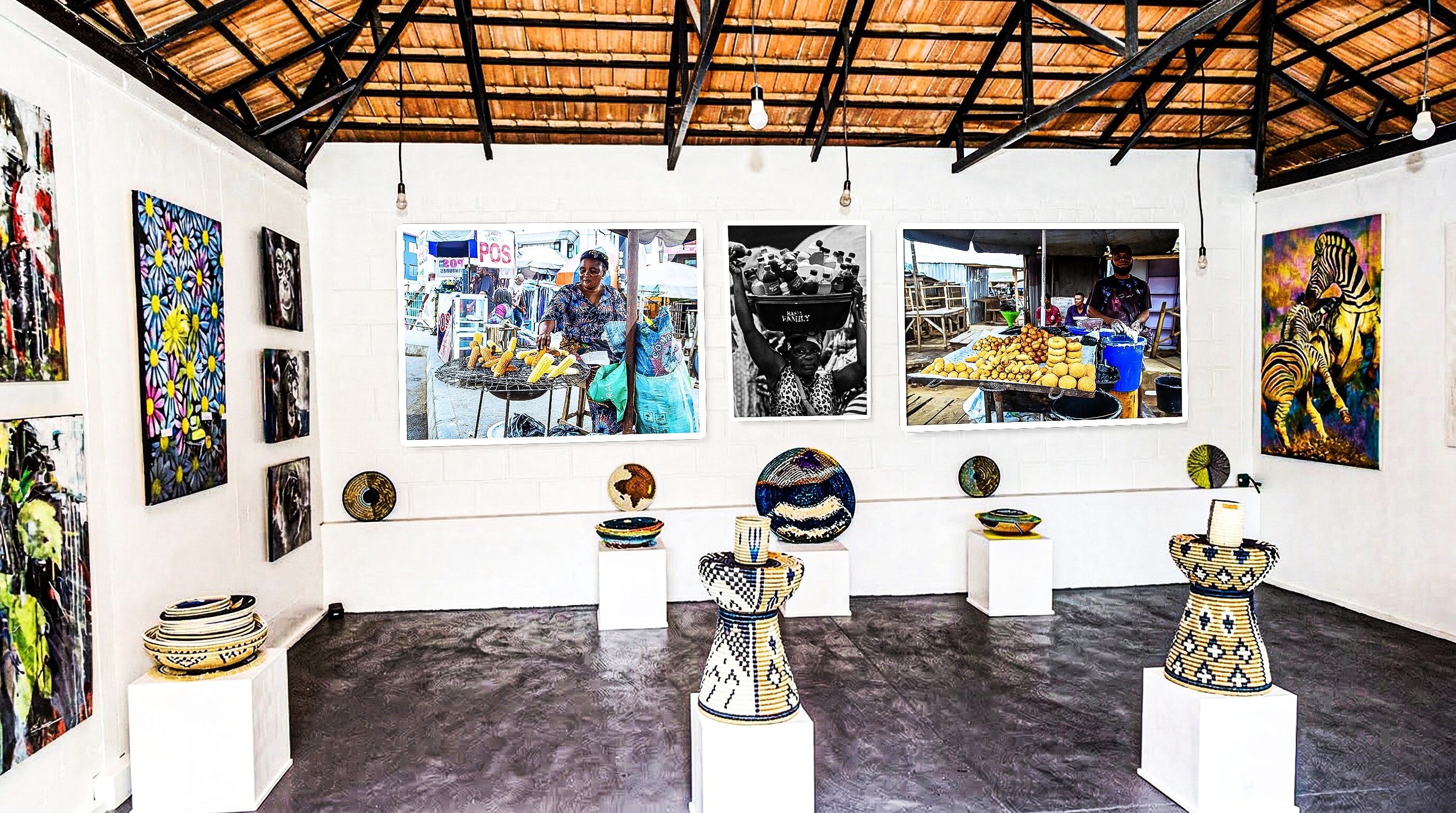
Presented at MADS Art Gallery on KG 598 St in the heart of Kigali from April 1 – May 10, 2024, Esther Okon’s Hands that Feed the City offers a measured and conceptually grounded body of fine art photography that examines labour as both subject and structure.
Within the gallery’s contemporary programme designed to immerse audiences in evolving conversations around art and culture the exhibition situates everyday urban activity within a formal photographic language that resists spectacle in favour of sustained observation.
Okon’s installation unfolds in a restrained linear sequence, allowing the photographs to be read not as isolated images but as a cohesive system of visual relationships. This curatorial pacing is central to the work’s effect.
Movement across the wall mirrors the cyclical rhythms of labour itself, repetition, pause, continuation while reinforcing the sense that each image participates in a larger, unresolved flow.
At the level of composition, Okon operates within a space between portraiture and still life, constructing images in which material and human presence are held in careful balance.
Food roasted corn, fried dough, plantains occupies the foreground with a density that recalls the still-life traditions of photographers such as Irving Penn, where everyday objects are elevated through formal precision.
Yet unlike Penn’s controlled studio environments, Okon’s materials remain embedded within lived contexts, retaining the textures and contingencies of the street.
This attention to materiality extends across the series. Metal grills, plastic containers, and improvised display surfaces are rendered with a clarity that gives them structural weight within the frame. These objects do not function as background detail; they organise the image, directing the viewer’s gaze and establishing a visual hierarchy that is constantly negotiated rather than fixed.
Human figures are integrated into these material fields without theatrical emphasis. Okon’s approach avoids emphasis on singular moments, instead attending to gestures, lifting, arranging, carrying—that are held in states of compositional equilibrium. These actions are neither incidental nor fleeting; they are structured within the frame with careful balance and restraint.
Hands, in particular, recur as both compositional and conceptual anchors, guiding the visual rhythm of the series while signalling the continuity of labour as an embodied and repeated practice.
In this respect, Okon’s work resonates with the environmental portraiture of Sungi Mlengeya, whose practice similarly situates the human figure within spatial and material contexts shaped by everyday experience.
While Mlengeya often reduces the environment to minimal, open fields of colour, Okon maintains the density of the lived environment, allowing material elements to remain active within the frame. This distinction underscores Okon’s commitment to constructing photographic space through accumulation and interaction rather than reduction.
A notable shift occurs in the black-and-white photograph of a woman balancing a basin of bottled drinks on her head. Here, the removal of colour foregrounds structure and form.
The triangular geometry of her raised arms introduces a sculptural logic, recalling the formal concerns of modernist photography while remaining grounded in a specific social context. The image functions less as documentation than as a study in balance, weight, and compositional tension.
Across the series, a consistent visual strategy is maintained: foregrounded materials, centrally positioned figures, and environments that frame acts of work. While this repetition reinforces the coherence of the exhibition, it also introduces a degree of visual predictability. A broader range of perspectives might have produced greater tension within the sequence. Yet this steadiness is also what allows the work to operate as a sustained meditation rather than a series of isolated statements.
What ultimately distinguishes Hands that Feed the City is its refusal to dramatise labour. Okon does not aestheticise hardship nor reduce her subjects to symbolic figures. Instead, she constructs a photographic language in which labour is understood as a system of gestures, repeated, adaptive, and materially grounded. The city, in her work, is not defined by architecture or infrastructure, but by the accumulation of these actions.
Within the context of contemporary African photography, the exhibition contributes to ongoing discussions around representation, materiality, and the politics of visibility.
Okon’s approach aligns with a generation of photographers who seek to move beyond spectacle, focusing instead on the formal and relational dimensions of everyday life.
In Hands that Feed the City, photography becomes a method of structuring attention. Through careful framing, sequencing, and control of visual elements, Okon renders the ordinary with clarity and weight, offering a body of work that is both formally resolved and critically engaged.
